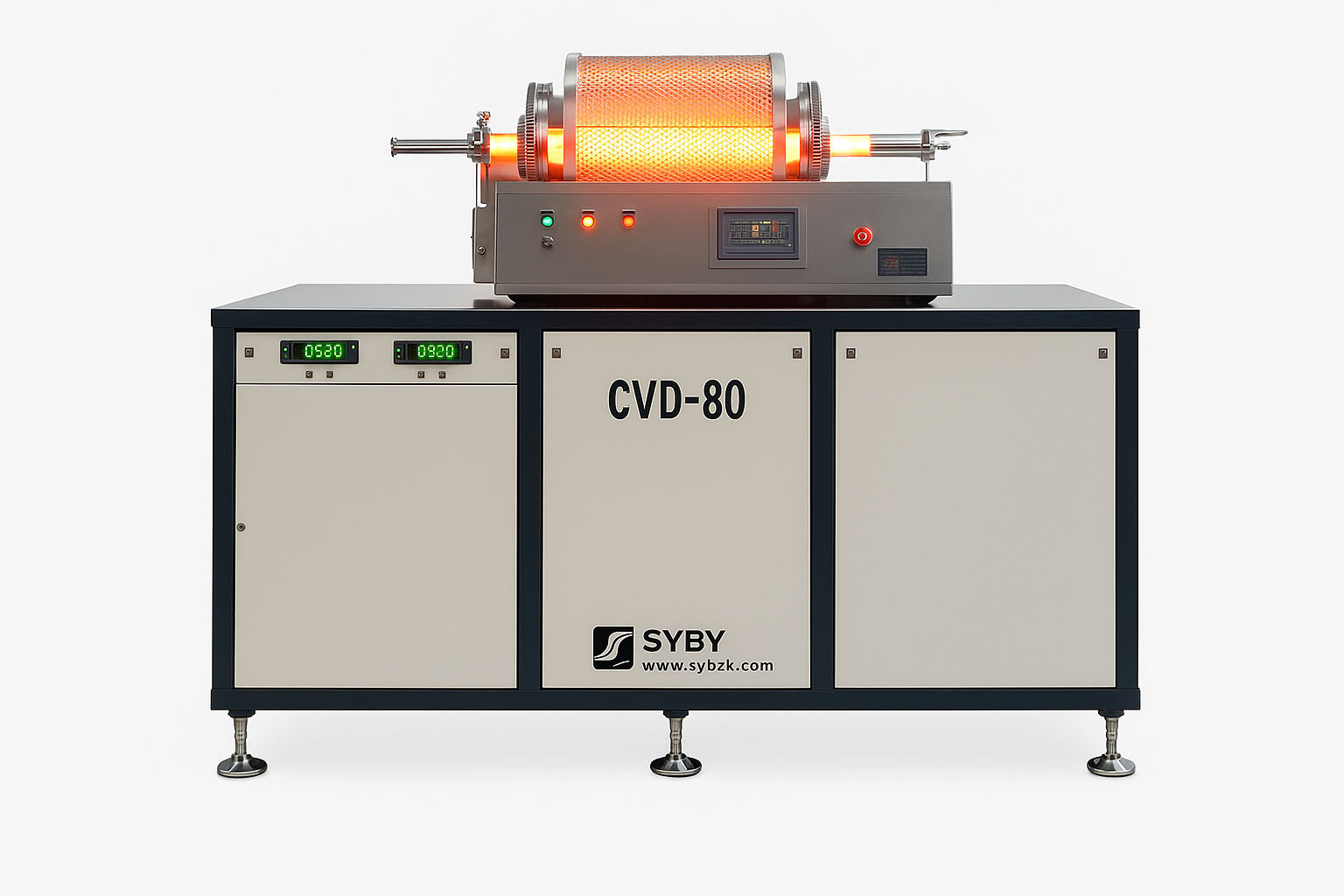
Structure and Specifications
The system adopts an Ion-Assisted Chemical Vapor Deposition (CVD) process, in which specific reactive gases are introduced into a vacuum chamber and excited by a high-power electric field to form plasma. Under these plasma conditions, chemical reactions occur and result in the formation of a dense coating on the workpiece surface. Compared with conventional CVD methods, this system enables high-quality deposition at relatively low temperatures, making it particularly suitable for complex-shaped or geometrically diverse components. The system features a compact structure and flexible operation, with optional vertical or horizontal chamber configurations to suit various applications and facilitate easy loading and unloading of workpieces.
Targets and Process Configuration
The system supports multiple reactive gases and ion-assisted processes to achieve highly uniform and strongly adherent coatings. By adjusting power density, gas ratios, and reaction time, the process can be optimized for different substrates and desired coating properties.
Common reactive gases include:
Methane (CH₄): For carbon-based or diamond-like (DLC) coatings
Nitrogen (N₂): For nitride coatings such as TiN, CrN
Hydrogen (H₂): For impurity reduction and improving film density
Oxygen (O₂): For oxide coatings such as Al₂O₃ and TiO₂
Typical depositable coatings include:
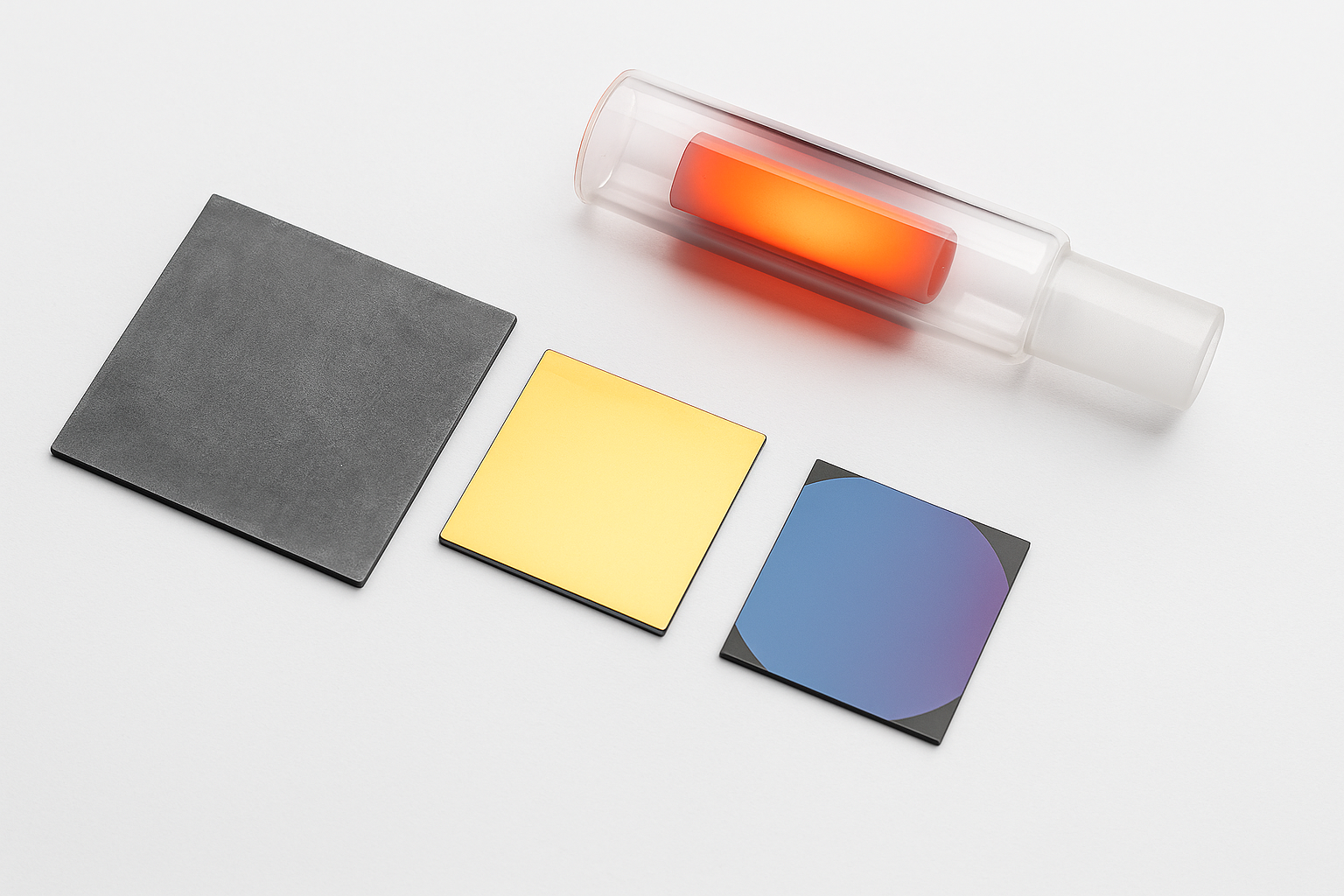
Hard protective coatings: TiN, CrN, ZrN, etc., for enhanced surface hardness and wear resistance
Functional protective coatings: Al₂O₃, SiO₂, etc., for corrosion resistance and insulation
Diamond-like carbon (DLC): With low friction coefficient and excellent wear resistance
Composite and gradient coatings: Achieved through co-deposition of multiple gases to form multilayer or graded structures
Vacuum and Control System
The system is equipped with a high-performance vacuum pumping unit (mechanical pump + roots or turbomolecular pump combination) to quickly establish and maintain a high-vacuum environment. Gas flow rates are precisely regulated by high-accuracy mass flow controllers (MFCs) to ensure stable gas composition during deposition.
The automated control platform allows real-time monitoring of key process parameters such as deposition rate, temperature, vacuum level, and gas ratios. It supports process curve recording, recipe storage, and one-click recall. Built-in temperature and gas interlock protections ensure process safety, repeatability, and traceability.
Process Advantages
Low deposition temperature (adjustable from 300–700 °C), suitable for heat-sensitive materials
Dense coating structure with strong adhesion and excellent wear and corrosion resistance
Capable of coating complex geometries and multi-angle surfaces with high thickness uniformity
High process repeatability, suitable for both R&D and production applications
Application Fields
The Ion-Assisted CVD system is widely used in industries requiring high hardness, wear resistance, and protective surface properties, including:
Precision mold strengthening and anti-sticking treatments
Wear- and corrosion-resistant coatings for complex components
Functional coatings for aerospace, energy, and medical equipment
Protective films for precision instruments and electronic components
By combining ion assistance with CVD technology, this system achieves coatings that feature both high adhesion and high density at relatively low temperatures. Its flexible process control, high-purity deposition environment, and superior coating quality make it an ideal surface engineering solution for research institutes and advanced manufacturing industries.